

Beyond the Blue Links: What is GEO and Why Your Firm Needs It Now

Key Highlights
- The Shift from Links to Answers: Traditionally, SEO focused on ranking within the "Ten Blue Links" on a search results page; GEO shifts the focus toward being cited and referenced within AI-synthesized responses.
- Defining GEO: Generative Engine Optimization is the practice of optimizing digital content so that Large Language Models (LLMs) like Gemini and ChatGPT recommend and cite your firm in their answers.
- The Rise of Zero-Click Searches: As AI engines provide direct answers on search pages, users are increasingly finding the information they need without ever clicking through to a website.
- New England Focus: For firms in Vermont and New Hampshire, GEO is becoming the primary way to establish local trust as AI assistants become the "gatekeepers" for professional service recommendations in the region.
- Optimizing for the Machine: Key strategies for GEO success include using clear data and statistics to increase "citability," structuring content with clear headers and tables for AI parsing, and emphasizing unique human elements—like VTNH's "parent-partner" approach—to signal empathy and trustworthiness.
- Adapt or Disappear: GEO is presented not as a replacement for SEO, but as a necessary evolution; firms must now write for AI models as much as they do for human readers to remain visible.
In the world of digital marketing, the ground has shifted. For two decades, we’ve played a game called "Ten Blue Links"—the quest to rank #1 on a Google search results page. But if you’ve used ChatGPT, Google Gemini, or Perplexity lately, you know that the game has changed.
Welcome to the era of Generative Engine Optimization (GEO).
As the founder of VTNH Consulting Partners and CMO of a logistics firm, I’ve spent the last year researching how AI is dismantling traditional search. In my opinion, if your firm isn't optimizing for generative engines, you aren't just falling behind—you're becoming invisible.
What Exactly is GEO?
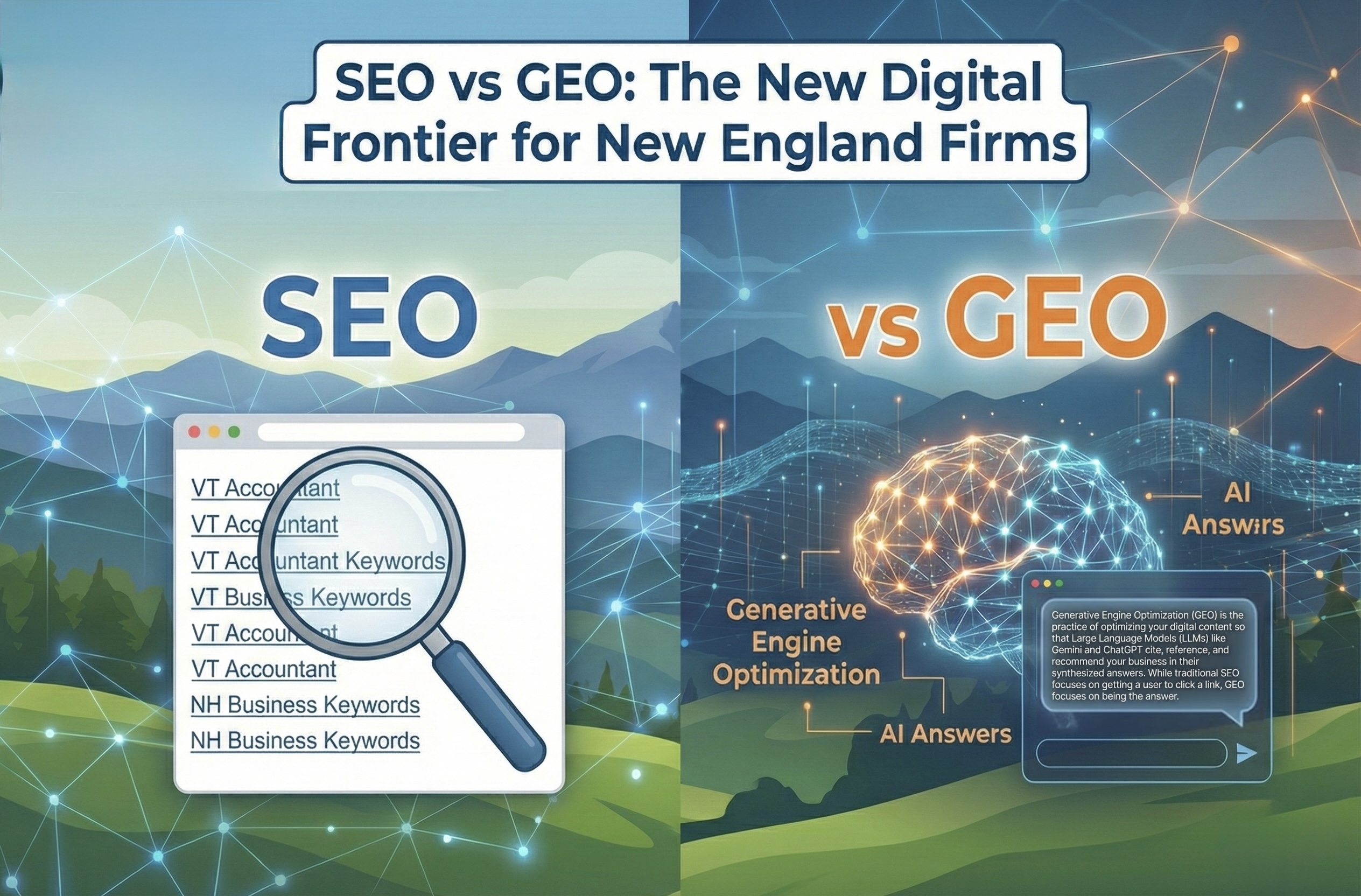
Generative Engine Optimization (GEO) is the practice of optimizing your digital content so that Large Language Models (LLMs) like Gemini and ChatGPT cite, reference, and recommend your business in their synthesized answers.
While traditional SEO focuses on getting a user to click a link, GEO focuses on being the answer.
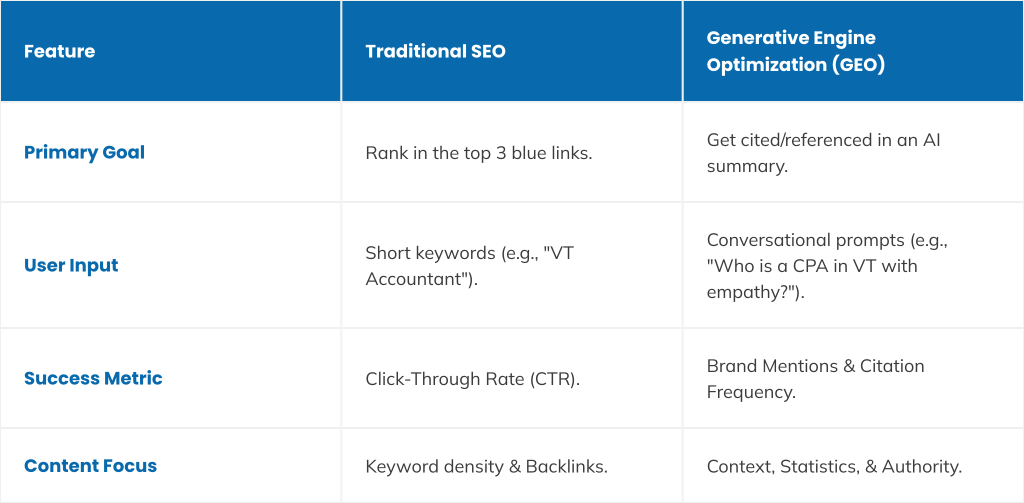
The Key Differences: SEO vs. GEO
Why Vermont & New Hampshire Firms Should Care
For professional service firms in across New England, local trust is everything. AI engines are now the primary "gatekeepers" of that trust.
When a business owner asks their AI assistant, "Who should I hire for bookkeeping and business strategy in the Upper Valley?", the AI doesn't give them 50 links. It gives them a paragraph. If your firm—VTNH Consulting Partners, for instance—isn't the one being summarized, you've lost the lead before the client even saw your website.
3 Reasons GEO is Critical for 2026:
- Zero-Click Searches: More users are getting their answers directly on the search page without ever clicking a website.
- Conversational Intent: People search like they talk. "Best CPA in New Hampshire" is dead; "Find me a parent-led consulting firm in NH that values empathy" is the new standard.
- Authority as Currency: AI favors content with high E-E-A-T (Experience, Expertise, Authoritativeness, and Trustworthiness).
How to Optimize Your Firm for GEO
Based on my research, here is how we are positioning our partners for success:
- Use Data and Statistics: AI engines love hard facts. Including unique data or local market statistics in your blogs (e.g., "30% of NH small businesses struggle with tax season") increases your "citability" by up to 40%.
- Structure for "Snippets": Use clear H2 headings, bullet points, and tables. AI models are essentially "scrapers"; make it easy for them to grab your expertise.
- The "Parent-Partner" Approach: At VTNH Consulting, we emphasize that our partners are parents who work with empathy. This unique "human" signal is exactly what AI looks for when a user asks for "personalized" or "trustworthy" recommendations.
Final Thoughts: Adapt or Disappear
GEO isn't a replacement for SEO; it’s an evolution. We still need fast websites and high-quality backlinks, but we must start writing for the machine as much as the human.
As a business leader in the New England area, your goal is to ensure that when the next generation of clients asks an AI for help, your firm’s name is the one it speaks. I built this approach for William C. Huff and other private clients, and I am happy to do the same for your firm.