

The ROI of Intelligence: A New England Executive’s Guide to AI Governance and Growth


The Highlight
From the Desk of Derek Showerman: In 2026, I’m seeing too many New England firms stuck in "pilot purgatory"—buying AI tools but seeing zero impact on their P&L. A recent MIT report via Fortune shows a staggering 95% of generative AI pilots are failing. If the big gorillas—companies with massive budgets and dedicated tech teams—are failing, then small and medium-sized businesses absolutely need the right guardrails to avoid the same fate.
Overview: AI Governance
In 2026, the "AI Honeymoon" is officially over. Whether I’m talking to business owners in Boston, MA, or private equity partners in Vermont, the question has shifted from "What can this do?" to "How do I make this profitable and safe?" The leaders winning right now aren't just adding "AI" to their budget; they are building AI-Native Operating Models. At VTNH Consulting Partners, we’ve identified four pillars that separate the high-growth firms from those just spinning their wheels and falling into that 95% failure bracket.
1. Governance as a Growth Engine (Not a Brake)
I often hear executives worry that governance will slow them down. In reality, clear governance is the "green light" that allows your team to move fast without the fear of data leaks or "Shadow AI." Without these guardrails, SMBs risk catastrophic failures that larger corporations might survive, but you cannot.
- The Verification Shift: In 2026, "trust me" doesn't work for auditors or investors. They want to see Model Cards and Data Lineage.
- The VTNH Strategy: We help you implement a "Review Gate"—a structured process where we triage every AI use case for risk and ROI before a single dollar is spent on implementation. Explore our Strategy Services here.
2. The Foundation: Data Integrity and "Digital Hygiene"
You can’t build an autonomous house on a swamp of messy data. Most of the firms I work with have decades of legacy data—siloed, duplicated, and unstructured. This is often the primary reason pilots fail.
- The 2026 Challenge: Modern AI needs Context-Ready Data. If your CRM and your billing software don't speak the same language, your AI will "hallucinate" errors that cost you money and reputation.
- The VTNH Difference: We start with a Digital Hygiene Audit. Before we look at tools, we clean up the "data swamp." We help you create a unified truth that powers your growth rather than polluting it.
3. From "Chatbots" to "Autonomous Workflows"
The real ROI in 2026 isn't found in a text box; it’s found in Autonomous AI—systems that can plan and execute multi-step tasks without you having to hold their hand. This is how we move you from the "failure" column to the "5% success" column.
- The Outcome: Imagine an autonomous workflow that handles the end-to-end reconciliation of your supply chain invoices, cross-referencing contracts and only flagging you if there’s a real problem.
- The High-ROI Move: Focus your spend on Cycle Time Reduction. If an AI tool doesn't turn a 5-day process into 5 minutes of background work, it’s not a strategic investment—it’s just another subscription fee.
4. The "Human-as-Manager" Model
The biggest bottleneck I see isn't the tech; it's the literacy gap. Most organizations don't actually know what AI tools their employees are using "under the table."
- The 2026 Reality: Your workforce needs to shift from "data entry" to "AI Management." Their value is no longer in doing the manual grunt work, but in auditing and validating the output of your autonomous systems.
- The VTNH Approach: We provide the Fractional C-Suite leadership to upskill your team. I work with you to ensure your people aren't replaced by AI, but are empowered to manage the digital workers doing the heavy lifting.
The Executive’s 2026 AI Checklist
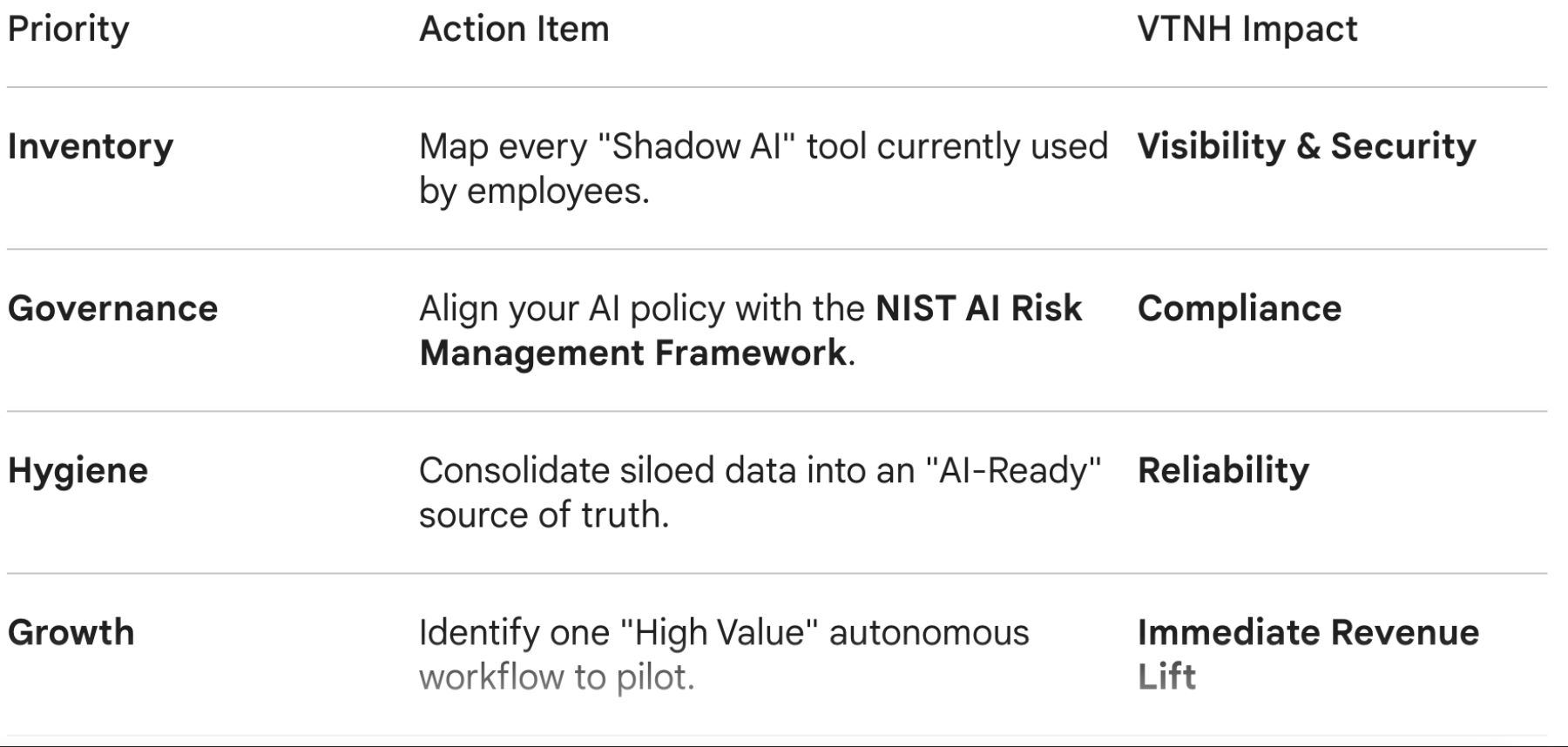
AI Governance Frequently Asked Questions (FAQ)
What is the NIST AI Risk Management Framework (AI RMF)?
The NIST AI RMF is the "gold standard" for managing AI risks. It’s a voluntary framework designed to help organizations promote trustworthy AI. It’s built on four functions: Govern, Map, Measure, and Manage. In 2026, aligning with NIST is the best way I’ve found for an executive to prove "due diligence" to their board.
Why are 95% of AI projects failing?
According to the latest research, failures stem from a lack of strategic alignment and poor data quality. Many companies treat AI as a "plug-and-play" tool rather than a structural change to their operating model.
How does "Fractional Leadership" help here?
Most mid-market firms don’t need a full-time Chief AI Officer. I provide that strategic oversight on a fractional basis, ensuring your AI initiatives are tied to your P&L goals and protected by the necessary guardrails to ensure you don't become part of the failure statistic.
Why VTNH Consulting Partners?
In a sea of tech-heavy agencies, we are Business-First. I understand the New England market—from the precision of manufacturing in NH to the rigor of professional services in Vermont. We don’t just "install AI"; we architect the strategies that make it a permanent, profitable part of your business.
The "Answer" for AI is no longer a tool—it’s a strategy.
Ready to bridge the ROI Gap? > Reach out to me at VTNH Consulting Partners to schedule your 2026 AI Readiness Audit. Let’s turn your AI experiments into an autonomous growth engine.