

The Death of the Traditional Funnel: Why Google’s "AI Mode" Makes Your Marketing Invisible

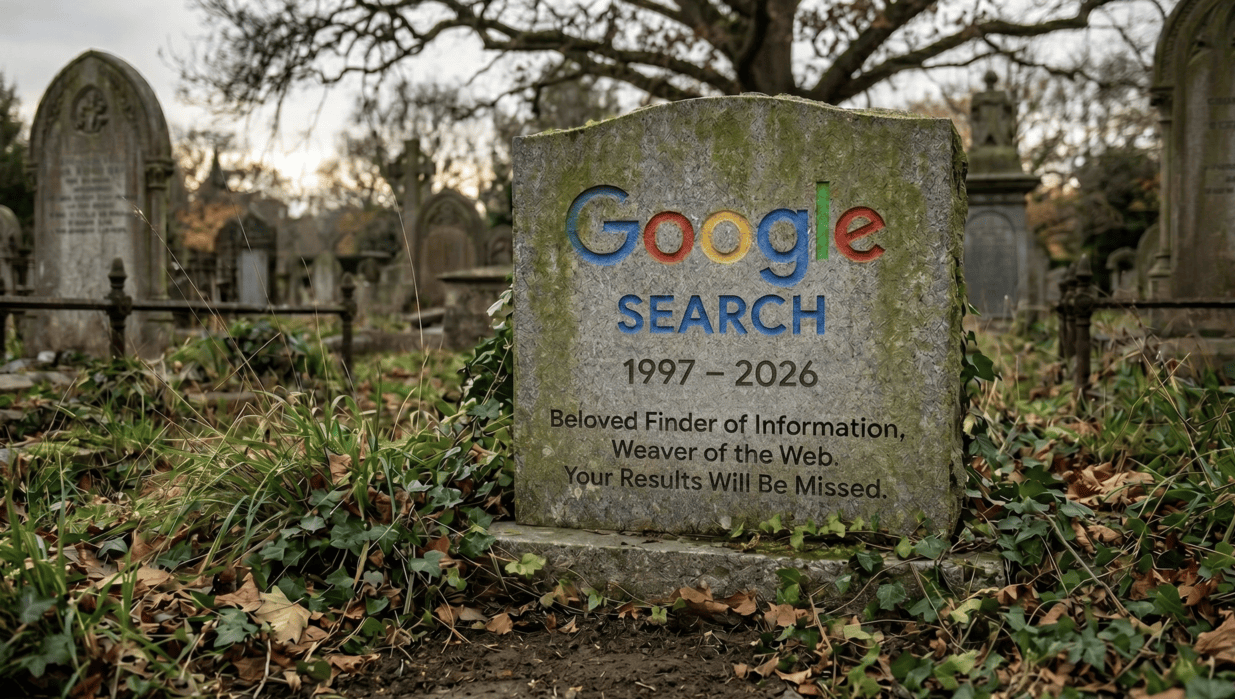
The Death of Google Search Highlights
The foundation of modern digital marketing just fractured, and most C-suite executives are still looking at the wrong blueprint.
At the recent Google I/O and Marketing Live events, Google dropped the most radical restructuring of its search architecture in 25 years. The headlining metric should make every Chief Marketing Officer stop in their tracks: Google's "AI Mode" has officially crossed 1 billion monthly users, with conversational query volumes more than doubling quarter-over-quarter. According to official announcements on the Google Keyword Blog, the search engine is being completely upgraded globally with Gemini 3.5 Flash to power autonomous, background-running "Search Agents."
While marketing departments are celebrating a 19% bump in Google’s search revenue as proof that "search is healthy," they are missing the massive undertow. Data from Semrush reveals that 92% to 94% of AI Mode sessions now end without a single click to an external website.
The traditional marketing funnel is full on dead. The search bar is no longer a vehicle for retrieving list entries; it is an autonomous agent synthesizing executive decisions.
The Compression: From Discovery to Purchase in a Single Window
For decades, marketing strategy was a game of steps: drive awareness, capture the click, optimize the landing page, nurture the lead, and eventually close the sale.
Google’s new architecture collapses that entire timeline into a single conversational window. Along with the user milestone, Google introduced two massive structural changes that completely disrupt the consumer journey:
- The GA4 "AI Assistant" Channel: Recognizing that conversational AI is permanently changing traffic, Google Analytics quietly rolled out a native AI Assistant traffic channel. Clicks originating from ChatGPT, Gemini, and Claude are now stripped from traditional organic or referral buckets and isolated. If you aren't tracking this row in your reporting, you are blind to your most valuable modern audience.
- Universal Cart & Agentic Commerce: Google rolled out its "Universal Cart" system, backed by the Universal Commerce Protocol. Operating natively across Search, Gemini, YouTube, and Gmail, it allows users to buy products directly inside the AI interface. Major retailers and Shopify merchants are integrating this summer, allowing AI agents to continuously monitor inventory, suggest alternatives, and execute checkouts via Google Wallet without the user ever visiting a brand's actual website.
The Hard Truth: If your brand isn't structured to be ingested, trusted, and cited inside the LLM's synthesis, your business is functionally invisible. You aren't just losing rankings; you are being locked out of the transaction phase entirely.
Moving Beyond Legacy SEO: What You Actually Need to Do
Right now, too many corporate budgets are burning cash on old-school keyword stuffing, desperately chasing a page-one reality that is shrinking by the day. If you want your business to survive in a market dominated by AI search and automated buying, you need to flip your digital playbook immediately.
1. Swap Keyword Stuffing for Semantic Chunking
AI models don’t care about keyword density; they evaluate context, authority, and structure. You need to re-architect your content into modular, "semantic chunks"—basically, highly structured, scannable blocks of text that clearly lay out a problem and its solution. When your data is clean and bite-sized, it’s incredibly easy for an AI model to pull your exact expertise and give your brand the credit as the definitive source.
2. Optimize for AI Citations, Not Just Raw Clicks
Yes, zero-click searches are going through the roof, but here is the silver lining: when your pages are explicitly cited inside an AI Overview, they see a massive 120% surge in click-through strength compared to standard links. Your marketing team's new core metric shouldn't be raw impression volume anymore—it needs to be Citation Share.
3. Build Deep Data Feeds for Universal Protocols
With Universal Cart managing checkouts across different platforms, having flawless data distribution isn't just a technical preference anymore—it's a baseline requirement. Mid-market and enterprise companies need to clean up their Merchant Centers and structural databases right now. If your backend systems aren't perfectly organized, autonomous AI agents won't be able to read your inventory, trust your data, or execute a seamless transaction.
The businesses that dominate this next era won't be the ones trying to outspend everyone on legacy ads. The winners will be the companies that adapt their digital architecture today, ensuring that when an AI agent goes hunting on behalf of a buyer, your brand is the obvious, undeniable choice.
To learn more about aligning your enterprise strategy with generative search mechanics, discover our framework analysis at vtnhconsultants.com.
For a deeper look into the exact structural shifts and feature breakdowns announced during this major search overhaul, you can watch this comprehensive breakdown of the Google I/O 2026 Search Updates, which details the rollout of the intelligent search box, information agents, and the mechanics of the Universal Cart protocol.
Frequently Asked Questions (FAQ)
1. What is Google’s AI Mode, and how does it change business visibility?
Google’s AI Mode represents a fundamental shift from link retrieval to autonomous decision synthesis. Powered by advanced Gemini models, it answers user queries by pulling data directly into a conversational interface. For businesses, this means traditional page-one text links are taking a backseat to AI-generated overviews. To maintain visibility, brands must ensure their data is structured cleanly enough for these models to pull, trust, and explicitly cite your insights.
2. What is semantic chunking, and how does it replace traditional SEO?
Traditional SEO focuses on inserting specific high-volume keywords into paragraphs to match rigid search queries. Semantic chunking is the practice of organizing your digital content into distinct, modular, context-rich blocks—such as structured Q&As, clear framework definitions, or explicit data tables. Because LLMs process information contextually rather than matching exact keywords, chunking makes it significantly easier for AI agents to ingest your expertise and attribute it to your brand.
3. How does the GA4 AI Assistant channel impact our reporting?
Google Analytics (GA4) introduced a dedicated AI Assistant traffic channel to separate traffic originating from conversational platforms (like Gemini, ChatGPT, and Claude) from standard organic search or referral buckets. If your marketing team is only looking at general organic traffic numbers, they are missing a critical indicator of modern brand health. Monitoring the AI Assistant channel tells you exactly how effectively your Generative Engine Optimization (GEO) strategies are converting automated AI interactions into real-world site visits.
4. What is Google’s Universal Cart protocol?
Universal Cart is a new agentic commerce feature that allows users to purchase items directly inside Google’s AI interfaces across Search, Gmail, and YouTube. Instead of clicking through to an e-commerce storefront, an AI assistant coordinates with backend merchant networks to check inventory, process payments through Google Wallet, and complete the order. To participate, enterprise and mid-market firms must aggressively optimize their structural product data feeds to be instantly readable by autonomous procurement agents.