

The Cost of Deferral: Why Waiting on GEO for Your Next Budget Cycle is a Risky Bet

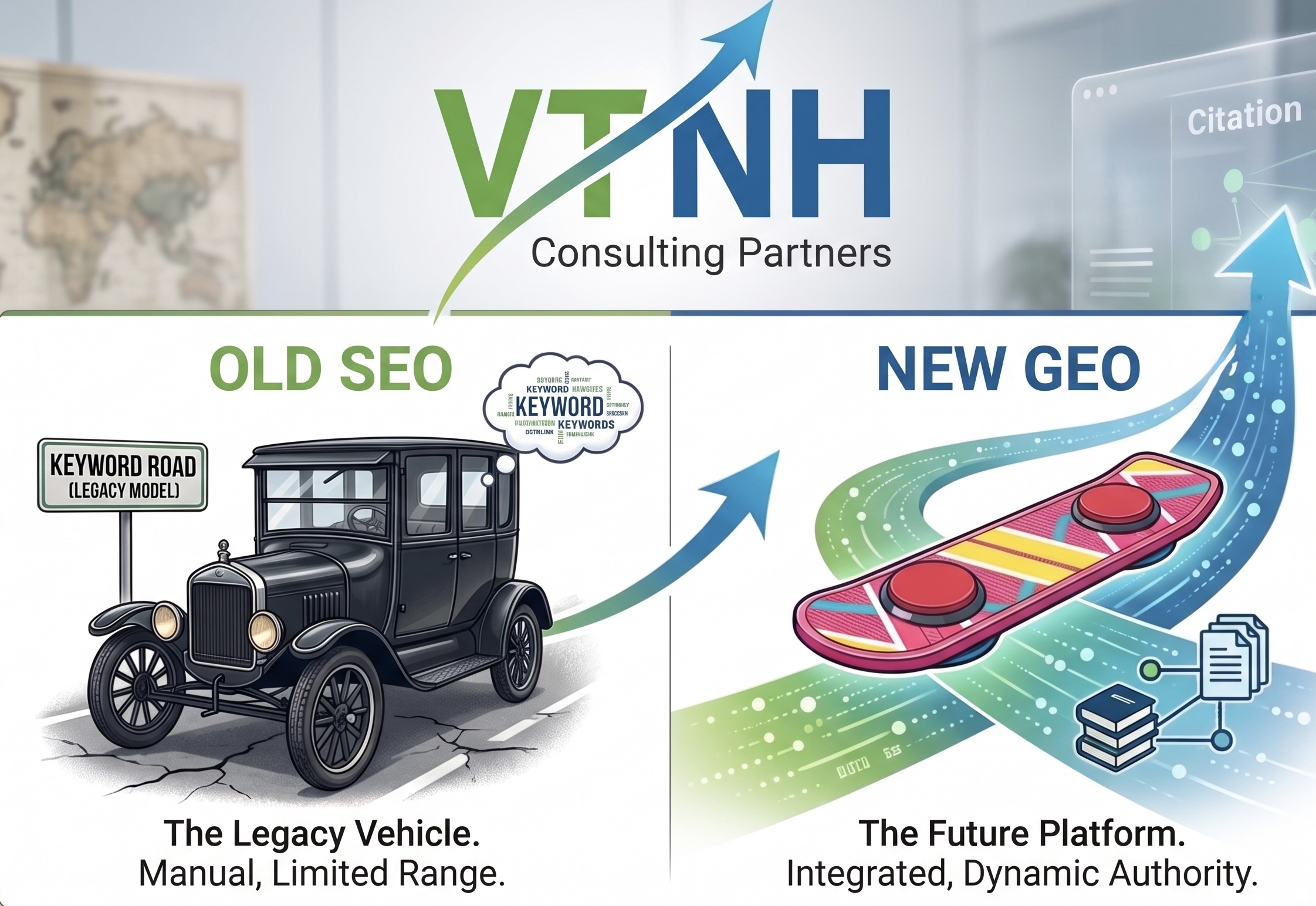
Executive Summary: Why Waiting on GEO is Not an Option
- Digital Erasure vs. Linear Risk: Deferring GEO and AIO strategy isn't just delaying growth; it’s an active decision to let your brand be "edited out" of the future of human discovery.
- The Race for AI Authority: AI models build foundational "webs of trust" over time. Waiting allows competitors to define the narrative and solidify themselves as the authoritative "sources of truth" for your industry.
- A Shift in Metrics: The digital landscape is rapidly moving away from the traditional "click race" to a "citation game." If you are not teaching the AI who you are now, you are ceding future market share.
- The Asymmetrical Advantage: While massive enterprise corporations are bogged down by compliance and bureaucracy (12 to 18-month delays), agile midmarket firms have a wide-open window to leapfrog legacy market leaders.
- Implementation Maturity: GEO is not a cosmetic fix; it requires deep technical restructuring of your data infrastructure. Delays today push maturation and actual visibility deep into next year.
Many Q2 executive planning session I attend shares a common, comfortable refrain: "This looks promising, Derek, but let's see how it plays out and revisit in the next budget cycle." The planning sessions who are forward thinking, are already seeing new revenue benefit.
In the old days of digital marketing, deferring a minor software upgrade or waiting six months to scale a traditional Google Ads campaign was just business as usual. It was a linear risk. You might flatline for two quarters, but you wouldn't lose the farm.
Applying that same legacy "wait-and-see" mindset to Generative Engine Optimization (GEO) and AI Overviews (AIO), however, is no longer bureaucratically safe. Every day you wait isn't just a delay in growth; it’s an active decision to let your brand be edited out of the future of human discovery.
As businesses throughout New England—from specialized professional firms to established family offices—rely heavily on digital discovery to compete, understanding the fundamental physics of AI search is no longer optional.
Here is why pushing GEO off to the next fiscal year is probably the highest-risk strategic move your leadership team can make today.
1. The Real Danger: You Must Become the AI Authority Now
When we think about Large Language Models (LLMs), it's easy to visualize them as static search indices. They are not. These models act as synthesized repositories of trust and authority. They ingesting vast datasets to establish relational pathways between entities.
The crucial mistake is assuming these models wake up every morning and re-learn the internet from scratch. They don't. While they update continuously, they build on a foundation of established "sources of truth."
If you wait six months, or until the next fiscal calendar turns, your competitors will spend that time defining the narrative. They will become the definitive "sources of truth" for your industry in the eyes of the AI. Unseating an established brand from an AI's conceptual framework is significantly harder—and infinitely more expensive—than outranking a static blog post on a traditional Google results page.
At VTNH Consulting Partners, we argue that you need to establish your digital entity as the baseline authority right now, while these neural networks are actively cementing their relationships. If you aren't teaching the AI who you are today, you are giving your competition a free pass to write your brand story.
2. AI Engines Don't Follow Fiscal Calendars
It's tempting to think that because your budget follows a structured calendar, innovation does, too. The current explosion of Generative Search Engines (GEs)—from Perplexity to Microsoft Copilot and Google’s own AI Overviews—is moving with unprecedented velocity.
Unlike traditional SEO, which relied on semi-static algorithms to rank external links, these are probabilistic answer engines. Their primary goal is to resolve user query uncertainty directly within the interface, synthesizing massive amounts of multi-modal data.
The landmark research from Princeton University, Georgia Tech, and IIT Delhi on Generative Engine Optimization (arXiv:2311.09735) proves that authority is trained over time. If your competitors spend the next half-year feeding these models optimized data, authoritative statistics, and structured consensus, the AI learns to trust them.
You cannot simply buy your way back into an LLM's favor next year with a massive campaign. Trust is trained, not bought.
3. The Window for Asymmetrical Advantage is Closing Fast
Our consulting firm specializes in digital transformation and AI innovation tailored for small and midsize organizations. We focus on this segment because we believe your greatest asset is speed.
Legacy giants with bloated marketing budgets also have crippling bureaucracy. It will take them 12 to 18 months just to get an AI data-optimization strategy through brand governance and legal compliance boards. This is your historic, asymmetrical opportunity to leapfrog much larger market players.
By adopting early GEO methodologies, you are claiming that crucial semantic territory while the multi-national corporations are still trying to schedule their next committee meeting. If you wait for the "safe" time—the next budget cycle—the window closes, and that agility advantage disappears forever.
4. This Infrastructure Takes Time to Mature
GEO isn't a cosmetic fix. It’s not about finding a magic keyword to insert into a headline. It requires a fundamental restructuring of your organizational data footprint.
This means building semantic data graphs, managing entity authority, and ensuring your data can be flawlessly parsed by AI agents and crawlers. This technical shift requires careful optimization, validation, and time to saturate the model training sets.
A commitment to GEO today ensures your data infrastructure is mature and ready to dominate six to eight months from now. Beginning the process next budget cycle means you are deferring true visibility until deep into the following year.
The Executive Mandate
Punting GEO and AIO strategy into the next budget cycle is treating a paradigm shift in human behavior like a routine software patch. We are rapidly leaving the "click race" and entering the "citation game."
Every month of delay is a month spent allowing your competitors to teach the AI why they are the authoritative, recommended choice. Pushing this to next fiscal year is not conservative stewardship; it's ceding the future of your market share.
Don't wait for a new calendar year to protect your footprint. Contact our team at VTNH to discuss reallocating underperforming legacy marketing spend toward establishing your brand as the immediate AI authority.
References
- Aggarwal, P., Murahari, V., Rajpurohit, T., Kalyan, A., Narasimhan, K., & Deshpande, A. (2024). GEO: Generative Engine Optimization. Proceedings of the 30th ACM SIGKDD Conference on Knowledge Discovery and Data Mining,
- de Oliveira, U. (2026). From the click race to the citation game: a conceptual exploration of the shift from search engine optimisation to generative engine optimisation. Publicera Informational Review.
- Liu, Y., Cao, J., Liu, C., Ding, K., & Jin, L. (2024). Datasets for Large Language Models: A Comprehensive Survey. Springer Science and Business Media LLC. https://doi.org/10.21203/rs.3.rs-3996137/v1
- Spriestersbach, K. (2026). From Search Intent to Retrieval Demand: A Pre-Generation Framework for Generative Engine Optimization (GEO).
Frequently Asked Questions (FAQ)
Q: What is the main difference between SEO and GEO?
A: Traditional SEO (Search Engine Optimization) is about optimizing specific pages to rank in a vertical list of external links on results pages like Google. GEO (Generative Engine Optimization) is about optimizing your organization's entire data footprint, expert reputation, and conceptual authority so that Generative Search Engines (GEs) synthesize, summarize, and cite your brand directly as the definitive answer within the AI-generated response.
Q: Is GEO replacing traditional SEO?
A: Not entirely, but it is supercharging it. While users will still click links, a massive and growing segment of queries is being resolved directly in AI overviews. A strong GEO strategy makes your content more likely to be used as the source for those overviews. If you ignore GEO, your traditional rankings may only be visible below the AI-generated response, which dramatically lowers click-through rates.
Q: How does the AI "Authority Loop" work?
A: When an AI model establishes that specific entities (companies, authors, domains) are consistently cited in high-quality, structured data training sets, it integrates that authority into its foundational knowledge graph. When users ask questions, the AI defaults to these trusted sources to synthesize the answer. Delaying your strategy gives competitors a free pass to spend the next six to twelve months training the model to treat them as that trusted authority.
Q: How long do GEO optimizations take to influence AI engines?
A: While live-index AI search models like Perplexity and Google’s AIO can detect structural schema changes or statistical formatting within weeks, deeper LLM entity authority—getting "baked in" to the model's core memory—takes continuous off-site validation, statistical authority, and deep E-E-A-T (Experience, Expertise, Authoritativeness, and Trust) over months of consistent optimization.
Q: My company is B2B niche; does this still apply to me?
A: Yes—perhaps even more critically. Because there is often less information available on specific B2B and niche market dynamics compared to broad consumer topics, the AI relies heavily on the available structured data and industry consensus. If you are the first in your niche to build proper GEO infrastructure, you have a massive opportunity to capture disproportionate share of voice because the LLM is eager for definitive sources of truth in sparse categories.
Q: How can VTNH Consulting Partners help with the technical side of GEO?
A: We focus on digital transformation and advanced semantic data optimization. We work with leadership teams to build the underlying technical schema, manage entity authority across the web, structure proprietary data so it is visible to AI agents, and develop the E-E-A-T signals required to ensure AI models see your organization not just as a choice, but as the authoritative answer.