
Beyond Basic ChatGPT: How Agentic AI Workflows Help Small Businesses Automate Operations (Without Losing the Human Touch)

Most small business owners across Vermont, New Hampshire, and New England have experimented with artificial intelligence by now. You or your team have likely used ChatGPT to draft an email, outline a blog post, or summarize a lengthy PDF document.
While generating text in seconds feels like progress, it rarely moves the needle on your bottom line. Generating copy faster does not fix broken software integrations, clean up disconnected client databases, or eliminate the manual handoffs draining your operational capacity.
This gap explains why so many regional mid-market firms remain stuck in “pilot purgatory,” paying monthly software subscriptions for generative AI tools while their staff continues doing manual data entry.
The game is shifting from basic Generative AI to Agentic AI Workflows.
If your goal is protecting operating margins, reducing administrative drag, and scaling revenue without adding overhead, understanding how agentic AI workflows for small business function is one of the most practical technology investments you can make this year.
The 2026 Shift: From Generative AI to Agentic AI
Generative AI is conversational. It waits for your prompt and produces text. Agentic AI is operational. It takes a high-level goal, plans the required steps, interacts with your existing software, and executes multi-step workflows end to end.
What Are Agentic AI Workflows for Small Business?
Traditional AI tools operate like a digital assistant waiting at a desk: you ask a question, and it gives you a written answer. Agentic AI workflows operate more like an autonomous operations manager. For a technical definition of goal-driven AI agents, see Google Cloud’s overview of AI agents.
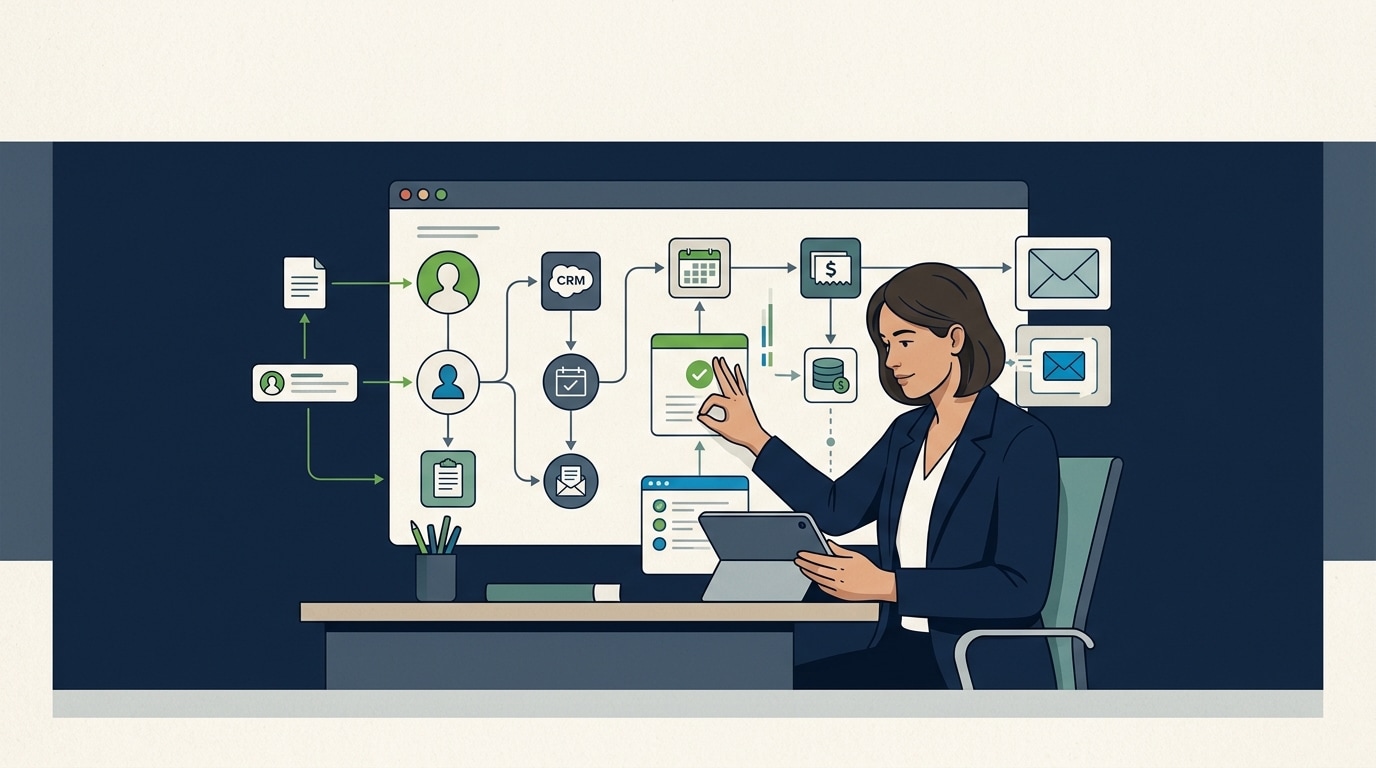
Instead of simply typing a response, an agentic system evaluates a task, breaks it down into sequential actions, connects to your existing software stack, such as your CRM, billing tools, and email marketing platforms, and carries out the work.
| Feature | Basic Generative AI, such as ChatGPT | Agentic AI Workflows |
|---|---|---|
| Primary function | Generates text, code, or static summaries. | Executes multi-step business procedures autonomously. |
| Software interaction | Isolated inside a single chat window. | Connects directly to CRM, ERP, finance, and email systems. |
| Human effort required | Staff must manually copy, paste, and execute steps. | Staff oversees outputs while the AI agent handles execution. |
| Business impact | A slight speed boost for drafting content. | Fewer manual handoffs and less structural revenue leakage. |
The Human Premium in an Agentic World
The core problem: Small and mid-sized businesses waste hundreds of hours each month bridging gaps between disconnected software platforms, forcing key staff to act as manual data conduits.
The agentic fix: Agentic workflows act as secure glue across your operational stack. They handle cross-platform routing, lead qualification, and reporting tasks without requiring an enterprise-sized IT department.
The strategic guardrail: Technology should amplify human strategy, not replace human judgment. At VTNH, we design workflows with a strict Human-in-the-Loop framework. Your team retains total control over critical customer touchpoints and strategic decisions, while the agentic system handles administrative execution.
Practical Examples: How Agentic AI Works in Real SMB Environments
You do not need a Fortune 500 budget to deploy agentic workflows. Here is how small businesses, professional service providers, and family offices across New England can use agentic execution to cut friction.
1. Inbound Lead Qualification and Onboarding
Old way: A prospect fills out a website form. A manager reads it hours later, manually checks calendar availability, sends an email back, creates a lead profile in the CRM, and drafts a service agreement.
The agentic workflow: The AI agent reads the submission, checks your CRM for duplicate records, verifies regional criteria, searches internal calendar availability, drafts a tailored preliminary proposal based on historical deal data, and sends a meeting invite, all within 90 seconds. Your sales team walks into a fully prepared call with zero manual setup.
2. Multi-System Client Onboarding and Billing Setup
Old way: Once a contract is signed, account managers manually create entries across billing software, project management boards, and client communication channels.
The agentic workflow: Upon contract sign-off, an AI agent triggers a cross-system workflow. It generates the deposit invoice, sets up the project structure in your management workspace, assigns initial onboarding tasks to team members based on capacity, and drafts a welcome email for review.
3. Family Office and Professional Services Reporting
Old way: Associates spend days collecting monthly statement PDFs from various institutions, manually extracting key figures, and pasting them into consolidated financial spreadsheets.
The agentic workflow: An autonomous agent securely retrieves monthly statements, parses and structures the underlying financial data, alerts staff to discrepancies, and populates executive dashboards.
Why You Need Agentic AI Consulting Before You Deploy
Deploying autonomous systems without clear strategic oversight can create serious operational risk. If your underlying business processes are messy or your data hygiene is poor, an AI agent will simply execute broken steps faster.
Partnering with an agentic AI consulting firm for small business helps establish three vital foundations before automation begins:
- Digital hygiene and data infrastructure: Modern AI needs clean, context-ready data. If your platforms do not speak the same language, AI tools will generate costly errors. We audit and align your software foundations first.
- NIST-aligned governance safeguards: Your client data, financial details, and proprietary methods must remain secure. We establish clear security boundary frameworks, following frameworks like the NIST AI Risk Management Framework, so your autonomous systems comply with industry standards.
- Operational alignment: Technology should fit how your organization operates. We focus on removing manual handoffs between marketing, sales, and operations to build a clean growth engine.
For a practical security checklist, review the OWASP Top 10 for Agentic Applications alongside your internal controls. For a broader governance perspective, read The ROI of Intelligence: A New England Executive’s Guide to AI Governance and Growth.
Frequently Asked Questions
What is the difference between Generative AI and Agentic AI?
Generative AI focuses on producing content, including text, images, or summaries, based on direct prompts. Agentic AI focuses on completing multi-step operational goals by autonomously planning steps, using tools, connecting to software databases, and completing tasks with minimal manual intervention.
Will agentic AI replace my existing small business staff?
No. The objective of agentic AI is to eliminate administrative drag and manual software handoffs. It elevates your existing team by taking over repetitive data management tasks, allowing employees to focus on high-value human activities such as strategic thinking, client relationship building, and executive decision-making.
Is agentic AI too expensive or complex for a small business?
Not when it is built on top of your existing tech stack. You do not need to build custom software or overhaul your entire IT department. Modern agentic workflows connect directly to popular platforms like Salesforce, HubSpot, QuickBooks, and project management tools, delivering immediate efficiency gains without unnecessary software development costs.
How do we keep AI agents from making costly mistakes with clients?
Through a strict Human-in-the-Loop operational architecture. While the agentic system automates background execution, including data retrieval, drafting, and cross-platform syncing, critical external communications, financial transactions, or final approvals always require explicit authorization from a team member.